
ROBOTIC LAWN MOWERS
Husqvarna Automower
Mammotion Mowers
Segway Navimow
Sunseeker Mowers
Accessories & More
Need help finding the right robotic mower?
Finding the perfect robotic mower for your lawn can be overwhelming. That’s why we’ve put together the information & tools below to help you choose the model that’s right for your needs.
Still unsure? Our experts are here to help. Feel free to call or email us for personalised advice.
EPOS, RTK & NRTK Explained
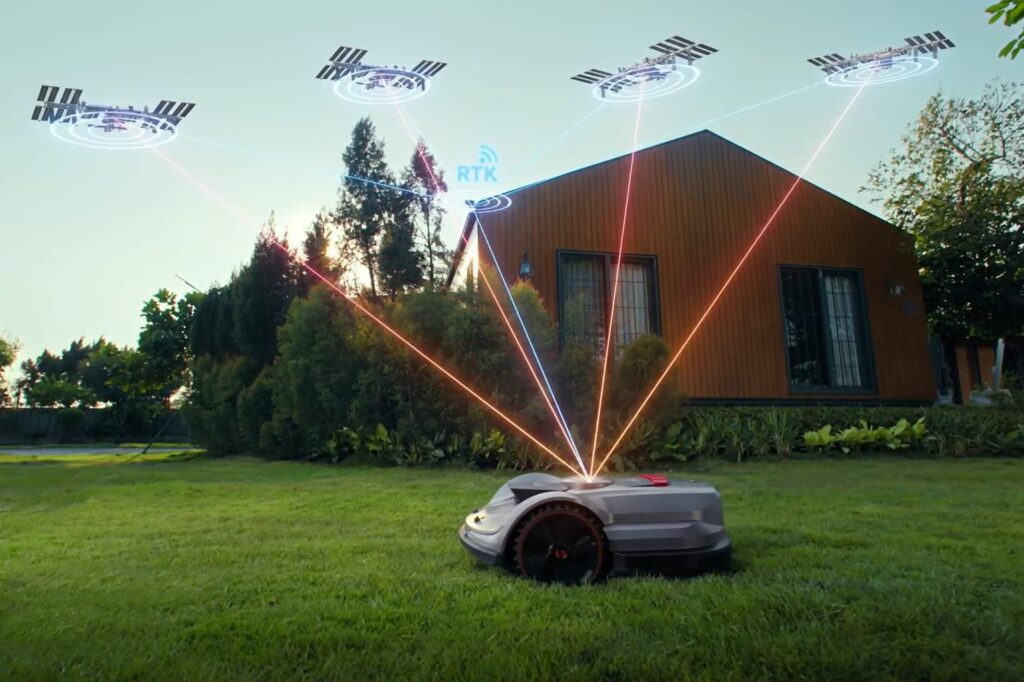
Most wire-free robotic mowers find their way using satellite positioning (GNSS). On its own, satellite positioning is only accurate to a few metres. That’s why mowers use RTK (Real-Time Kinematic) correction data to get it down to a few centimetres. The difference between the systems is how that correction data reaches the mower.
RTK (local reference station): you fit a small antenna, or reference station, in the garden with a clear view of the sky. It watches the same satellites as the mower and sends corrections straight to it by radio. It doesn’t need the internet.
Network RTK (NRTK): there’s nothing to install. The mower gets its corrections over 4G or Wi-Fi from a network of professional reference stations around the country, so it needs a steady mobile or Wi-Fi signal across the whole lawn.
EPOS (Exact Positioning Operating System) is Husqvarna’s name for its RTK system. It isn’t a different technology. EPOS Automowers can run either way: on Husqvarna Cloud (network RTK over 4G or Wi-Fi, no extra cost and nothing to install) or with an EPOS reference station (RS1 covers up to 100 m and RS5 up to 500 m, with no internet needed).
Whichever system you choose: the mower itself still needs a good view of the sky. Tall trees, buildings and narrow side passages can block satellites, which is why many mowers also use cameras (VSLAM) or LiDAR. Who uses what: Husqvarna EPOS Automowers can use Cloud or a reference station. Segway Navimow, depending on the model, uses a local RTK antenna or network RTK. Mammotion uses iNavi network RTK. Sunseeker Elite X3 Gen 2, X5 Gen 2, X7 / X7 Plus Gen 2 and X9 / X9 Plus use network RTK over a built-in 4G module, backed up by cameras (VSLAM), with no antenna needed. An optional Sunseeker RTK antenna is available. The Sunseeker Elite X4 doesn’t use RTK at all: it finds its way with 360° LiDAR and cameras, with no wire and no antenna. Not sure what suits your garden? Give us a call.
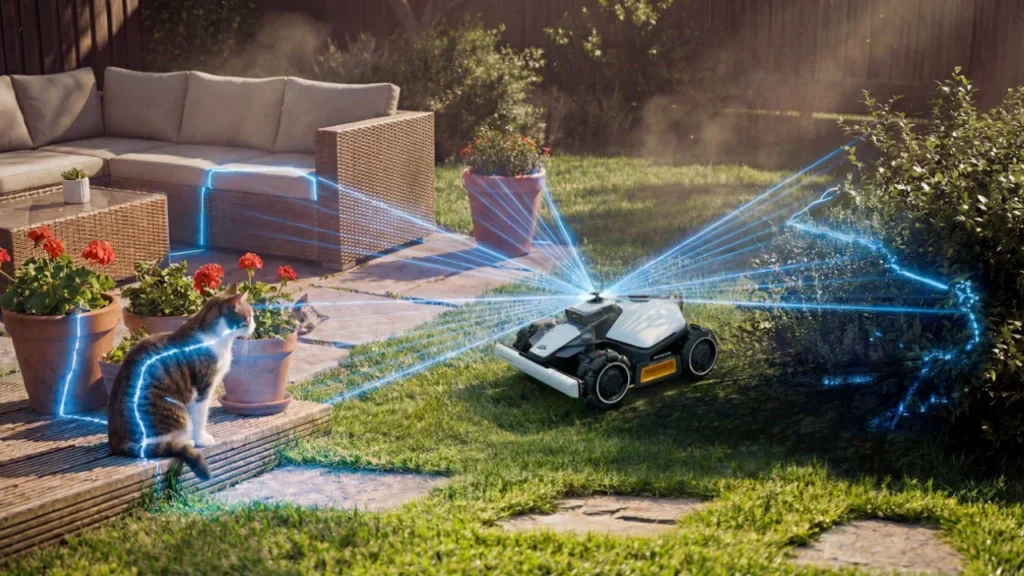
What is LiDAR?
Instant Harden Mapping: The first time you turn the mower on, its spinning Lidar sensor sweeps the yard with thousands of laser pulses per second. It builds a highly accurate, centimeter-level 3D virtual map of your property on its very first pass.
Flawless Obstacle Avoidance: If a dog toy, patio chair, or stray garden hose is left on the lawn, the Lidar system detects it in real-time. The mower will cleanly pivot and cut around the object rather than running it over or getting stuck.
Works Under Trees and Fences: A major competitor to Lidar is RTK (Satellite GPS). While RTK is great for wide-open spaces, it loses signal under heavy tree canopies, near tall fences, or next to house walls. Lidar doesn’t care about satellite signals—it relies entirely on its onboard laser, meaning it never gets lost in the shade.
Mows in the Dark: Because Lidar supplies its own light source via lasers, it functions perfectly in pitch-black conditions. You can schedule the mower to run at 2:00 AM so you wake up to a freshly cut lawn, without needing yard lights on.
Selectable Mowing Patterns
Robotic lawn mowers primarily navigate yards using four main cutting patterns, each suited for different turf needs. The most common is the random pattern, where the mower travels in straight lines and changes direction whenever it meets a boundary, gradually crisscrossing the entire yard from multiple angles to prevent wheel ruts and keep the grass growing upright. For a faster, more structured cut, mowers can deploy a parallel or zigzag pattern, moving back and forth in organized rows to minimize overlap and leave clean, uniform stripes.
To achieve a premium look, a checkerboard pattern builds on this by executing a second pass at a 90-degree angle, creating a distinct, sports-field grid that ensures deep coverage. Finally, mowers often utilize a spiral or spot-mowing pattern, which automatically triggers when a dense or tall patch of grass is detected, forcing the mower to circle outward to thoroughly mulch that specific area before resuming its normal routine.
Lawn Size Calculator
- Search your address
- Click each corner of your lawn
- Press Finish shape